Peter Max’s “Umbrella Man” — origins in the 1980s Neo-Fauve period, key studio variations (“on Blends” and more), common formats & specs, quick authentication cues, and recent market results — with a brief look at the Max + Mira framed presentation.
Peter Max’s Umbrella Man: Origins, Variations, and Collector Notes
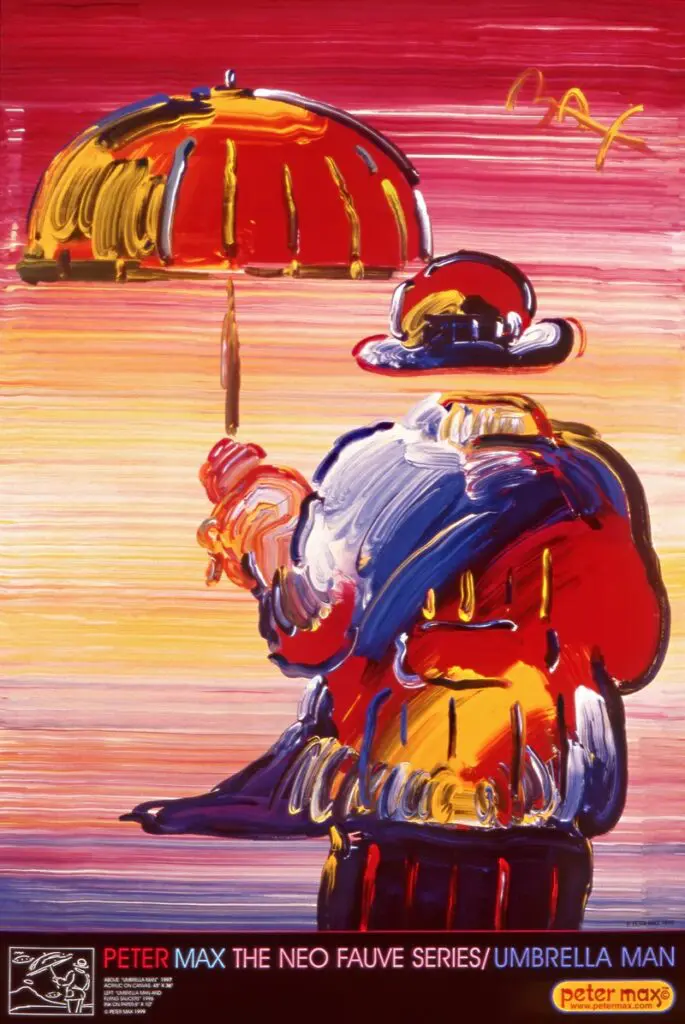
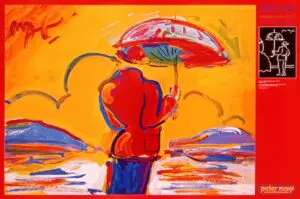
Umbrella Man poster available signed and dedicated through PeterMax.com
Origins of the Icon
Umbrella Man emerged in the 1980s during Peter Max’s “Neo-Fauve” period, when he leaned into high-chroma palettes, kinetic brushwork, and improvisational energy. The inspiration, per the official studio account, was a photograph of cellist Pablo Casals on a beach—transformed by Max into a cinematic, almost Felliniesque figure in coat, hat, and umbrella, poised before a radiant horizon. The result is less a portrait than an emblem—an archetype of poise and optimism rendered in surges of color.
“As I continued to paint using my new freestyle techniques, I allowed myself the freedom of painting just for the sake of abstraction, composition, and color combinations, when something else began to emerge. Themes and iconic figures developed, much as my cosmic figures did when they mysteriously appeared in my 1960s drawings. I gave my new painted figure names like ‘Dega Man,’ ‘Zero Megalopolis,’ ‘Umbrella Man,’ ‘Sage with Cane,’ and ‘Blushing Beauty.’”
— Peter Max
As viewers step into the world of Umbrella Man, a vibrant scene unfolds—an enigmatic figure, expressed in a whirlwind of color and motion, standing before a calm blend of hues, holding aloft an umbrella that seems to radiate energy. The umbrella functions both as a literal shelter and as a metaphor for resilience and inner calm amid life’s storms.
Print Editions and Media Variations
Collectors encounter Umbrella Man across a wide range of formats: original acrylics on canvas, hand-pulled serigraphs on paper, lithographs, and later mixed-media prints enhanced with hand-applied acrylic overpainting of varying levels of detail. Early serigraphs are prized for crisp color separations and substantial paper stocks; later prints often carry an embossed studio/printer chop with pencil signature in the margin.
Color palettes vary dramatically—from cool blues and lavenders to fiery sunset palettes. This is part of what keeps Umbrella Man fresh for each version. Framing preferences often favor black or brass-accented profiles that echo period presentations.
Additional Variations (and an official studio reference)
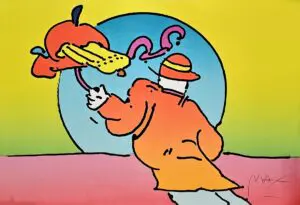
Umbrella Man I
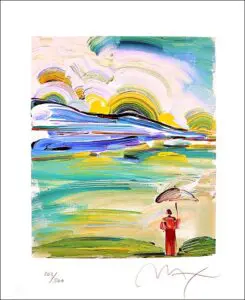
Umbrella Man at Sunrise
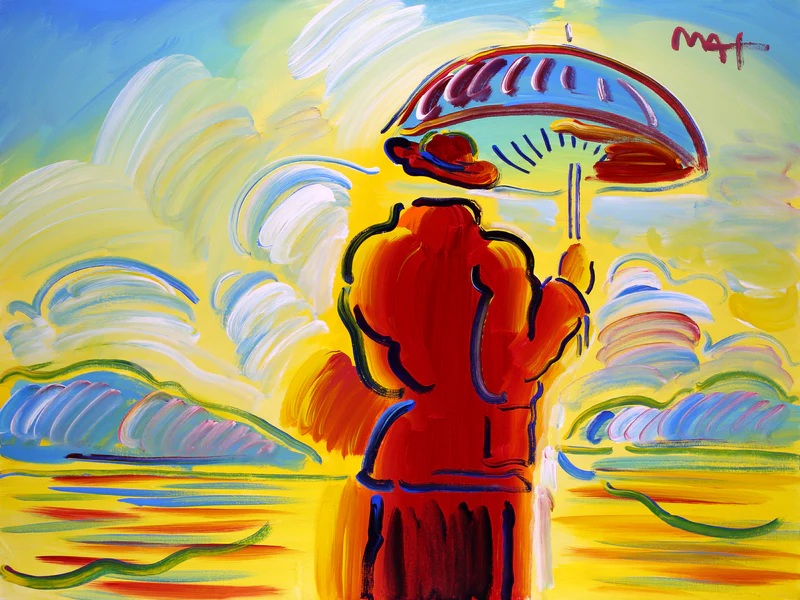
The iconic studio presentation is often described as “Umbrella Man on Blends”—the lone figure set against a soft, color-blend background. Max also explored related interpretations such as Umbrella Man I, Umbrella Man at Sunrise, Umbrella Man at Sea, and Umbrella Man with Landscape III (Version IV #4), many developed within the 1980s Neo-Fauve arc and beyond.
For official studio examples and descriptions, see: Peter Max — Umbrella Man (external).
Umbrella Man at Sea
Umbrella Man with Landscape III (Version IV #4)
Dimensions & Specs — Common Formats of “Umbrella Man”
- Original media: Acrylic on canvas (hand-painted by Peter Max)
- Limited editions: Hand-pulled serigraphs; later lithographs and mixed-media prints
- Typical image sizes: 8×10 in, 11×14 in, 18×24 in (varies by series)
- Edition markings: Numbered in pencil (e.g., “123/300”) with embossed studio/printer chop
- Framing: Black, gold, or two-tone wood frames; under glass or acrylic glazing
- Signature: Graphite “Peter Max” signature at lower right on genuine prints (note: some later offerings may be studio-signed; confirm signing method in the listing or COA)
Authentication at a Glance (full guide coming in the next article)
- Marks: Pencil signature (lower right) + blind emboss/printer’s chop; edition numbers or A.P./P.P./H.C. notations where applicable.
- Print quality: True serigraphs show dense pigment laydown with subtle edge ridges; offsets look flatter, with visible dot patterns under magnification.
- Condition: Check for toned paper, trimmed margins, foxing, mat burn, and color fading—especially in high-chroma passages.
For step-by-step checks, comparison photos, and common red flags, see our upcoming guide: “How to Authenticate a Peter Max Umbrella Man (Quick Checklist).”
Market Context and Collector Notes
Because Umbrella Man exists in a wide spectrum of authorized formats—from hand-painted canvases to studio-signed prints—prices vary dramatically. The official Peter Max Studio site has offered signed and dedicated prints measuring approximately 36 × 24 inches for around $355, a figure reflecting modern studio-signed editions rather than pieces personally signed by Max himself. (The artist has not personally inscribed new works in recent years due to health decline; most current signatures represent authorized studio facsimiles.)
On the higher end, hand-painted mixed-media canvases and authenticated early serigraphs continue to command mid-four- to low-five-figure results at auction. Representative public auction results include:
- Umbrella Man with Rainbow Sky, oil on canvas (approx. 27.5 × 21.25 in): $11,875 (Heritage, 2022)
- Hand-colored lithograph (approx. 32 × 24 in): $4,250 (Heritage, 2019)
- Screenprint with acrylic & mixed media on paper (approx. 10 × 8 in): $2,750 (Heritage, 2017)
- Acrylic & mixed media on canvas (approx. 12 × 9 in): $5,280 (John Moran, 2024)
- Small mixed-media on paper (approx. 6 × 10.5 in): $924 (John Moran, 2025)
- Sculptural interpretation, Umbrella Man III: $6,000 (Billings, 2024)
In addition to public auctions, gallery and retail listings vary widely. Park West Gallery—long a major distributor of Peter Max’s work through exhibitions and cruise-ship sales—has offered multiple Umbrella Man pieces, including a large signed acrylic sculpture appraised at about $34,500. Painted and framed versions have appeared online with asking prices typically between $20,000 and $47,000 depending on size, medium, and provenance.
Interesting Facts about Umbrella Man
- Jazz influence: Max’s love of jazz—its rhythm and improvisation—animates the dynamic movement of the motif.
- Iconic umbrella motif: The umbrella recurred throughout Max’s career as a symbol of protection and unity; Umbrella Man is its most iconic expression.
- Peace & positivity: Emerging in the 1980s yet echoing the optimism of his earlier ideals, the figure carries Max’s message of hope and human connection.
- Color explosion: Bold, expressive color remains central to the work’s impact—each hue amplifying the optimism at the heart of Max’s vision.
Enduring Legacy
More than forty years after its introduction, Umbrella Man endures as one of Peter Max’s most beloved images—a fusion of pop exuberance, spiritual calm, and painterly energy. Whether encountered as a hand-pulled serigraph, a painted canvas, or a modern reinterpretation such as the Max + Mira Umbrella Man, it invites viewers to find light in the storm and color in the ordinary.
Sources & References
- Official studio feature and variations: Peter Max — Umbrella Man
- Public auction archives: Heritage Auctions; John Moran; Billings (individual lots as cited above).
Click for more articles in Peter Max News.
Peter Max Artwork Reimagined
Through Juan Mira’s artistry, MacDonald Gallery has made it more accessible to own authentic Peter Max artwork and a hand-painted piece in one. Each work features a rare Peter Max lithograph print set within a hand-painted mat by Juan Mira, who expands the original image as an integrated painting. The result merges two creative visions into a single, vibrant composition — available exclusively in our Art and Paintings collection.
Lifetime Collector Guarantee applies to Originals and Mixed-Media works. © MacDonald Gallery, Adwin Blake, Curator.
New Peter Max – Juan Mira works being released!
6 Must-Know Facts About Peter Max Prints
7 Ways to Spot a Peter Max Fake