Juan Mira, The Elusive Artist

Juan Mira is an extremely elusive artist. He puts his artwork in the limelight while he remains in the shadows. He does not make public appearances or promote himself, but prefers letting his artwork speak for him. It is all about the art.
The Peter Max Connection
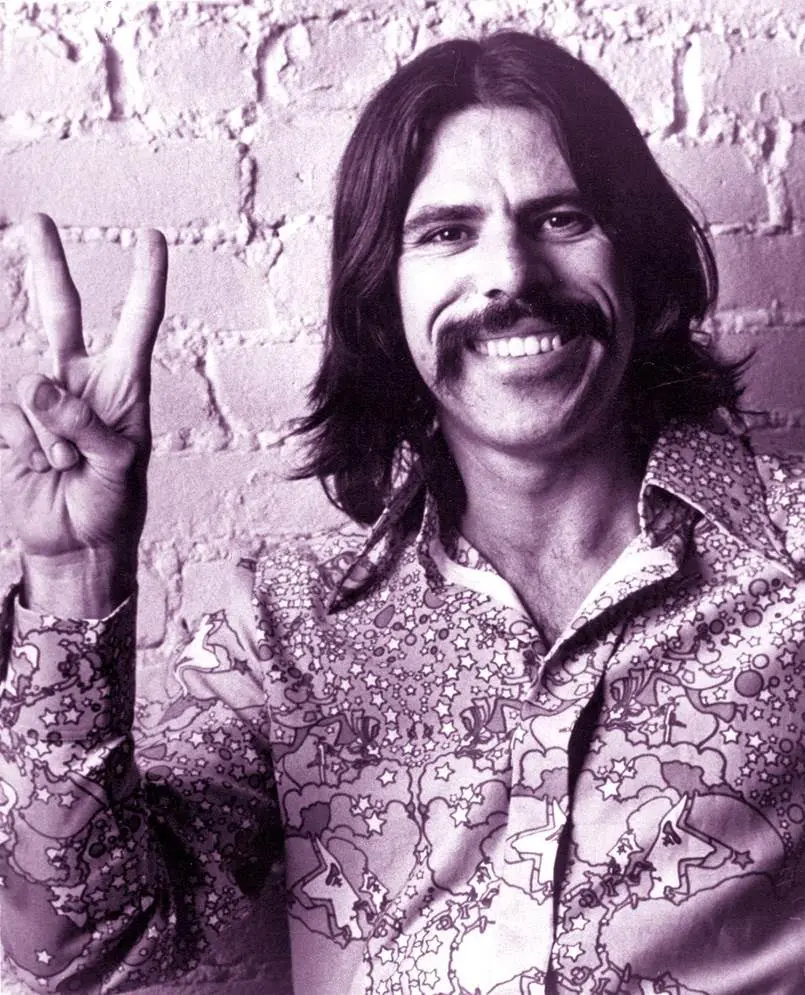
Juan Mira’s art is obviously and deeply influenced by Peter Max. In the late 60’s and early 70’s, as a young boy, Mira was surrounded by the art of Peter Max — from the pencils and notebooks he used in school to the many posters and pictures that were pop culture of the era. Interestingly, as a boy Mira did not try to emulate Peter Max outright; the paint jobs on his made-up fantasy motorcycles simply appeared in a Peter Max style, absorbed rather than copied. Young Mira was, at the time, more consciously infatuated with drawing characters from Mad and Cracked magazines.
Max’s influence came back to him later in life — first through an actual Peter Max piece purchased by his parents, then decades afterward when, working on his own art, Max’s visual language resurfaced unbidden and grew into a near obsession.
Like Max, Mira paints in a contemporary Pop Art style built on bold color and broad, confident strokes, and he keeps close to many of the themes Max made iconic — umbrellas, galactic skies, flowers, flags, hearts, sunsets. To really get inside how Max’s paintings worked, Mira spent years painting close studies of Max’s own compositions — a practice he still returns to on occasion. As he grew more comfortable and confident, he began adding his own elements. That’s where Juan Mira, as a distinct artistic voice, actually starts.
The Two-Stage Process
Ask Mira how a painting comes together and he’ll describe it as a two-stage process — and once you know to look for it, it’s visible in almost everything he’s painted since.
Stage One is the foundation. This is where Max’s vocabulary does its work: the high-vibrancy palette, the cosmic layouts, the graphic confidence that made Max’s paintings legible and electric from across a room. Color sets the tone before the viewer has consciously registered a single detail.
Stage Two is where Mira steps in. Once that energy is established, he alters the imagery to introduce something Max’s own work — for all its brilliance — rarely spent much time on: emotional narrative. Max’s figures were often, by his own design, graphic symbols — beautiful shapes built to catch light and complete a composition. Mira’s second stage takes those shapes and gives them an inner life. A silhouette becomes a couple in the middle of a marriage proposal. A lone figure becomes two, tenderly leaning into each other. A single character becomes a family.
Mira has put it simply: Max’s paintings are one stage. Mine are two. The color is the setup. The image is the payoff.
Changing Some Key Elements
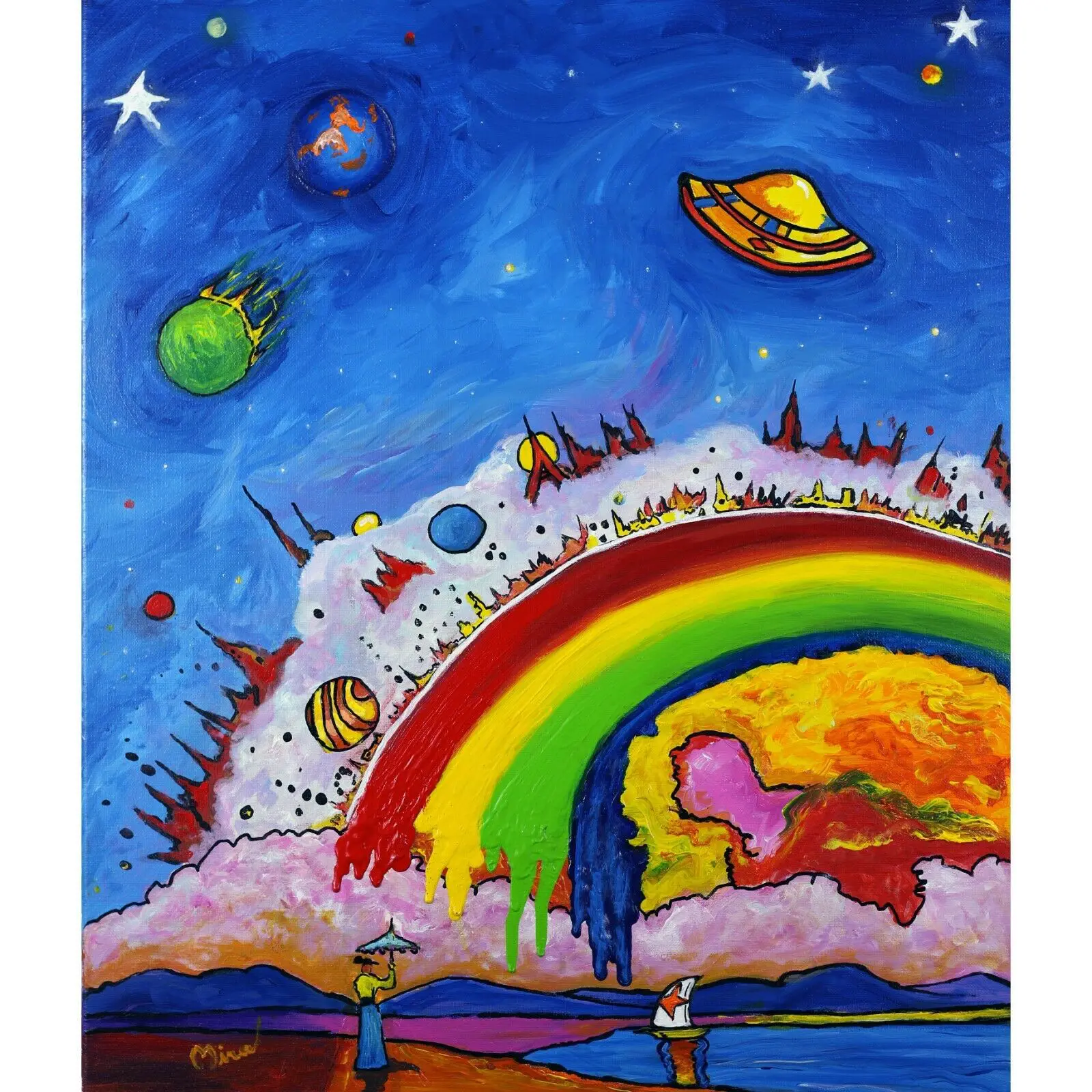
Umbrella Lady Under The Rainbow
Umbrella Lady Under The Rainbow
As a diversion and varying a Peter Max painting, Mira sometimes maintains the basics, but adds in his own artistic statement by changing key characters and images.
Umbrella Lady Under The Rainbow is an earthly landscape with a burst of colorful galactic intervention. Umbrella Lady is out for a “galactic” stroll under a colorful dripping rainbow. The two key elements that Mira changed were the Umbrella Lady and the addition of the predominantly colorful flowing rainbow. This painting is available in our Art and Paintings.
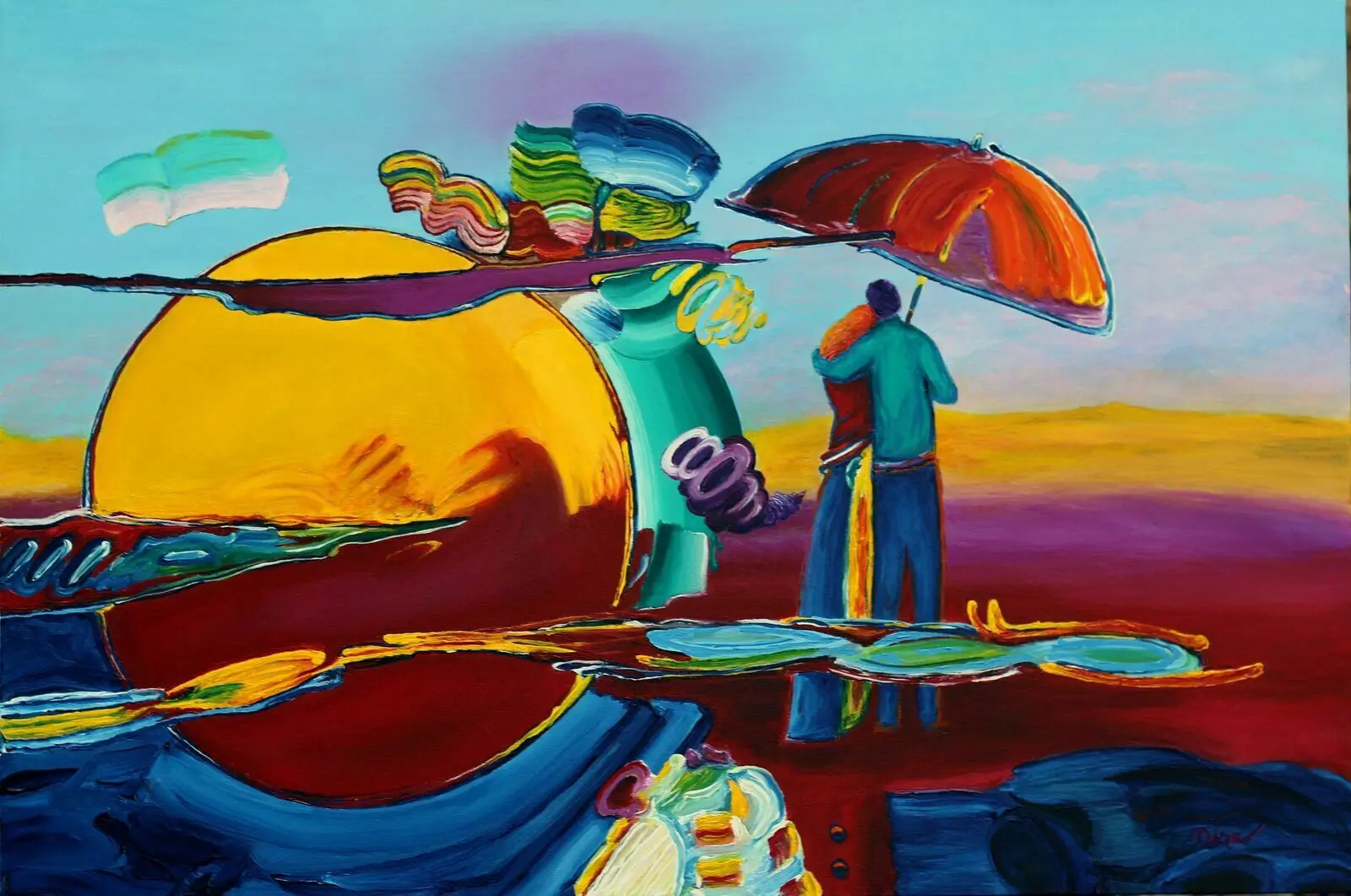
Umbrella Couple with New Moon
Taken from Peter Max’s New Moon, Umbrella Couple with New Moon adds a whole different feeling to the composition. The couple tenderly embracing under the umbrella instills a loving, sentimental, emotional touch that becomes the feature of the painting.
On occasion, Mira paints commissions for various clients. That is how Umbrella Couple with New Moon came about. A client wanted to buy several pieces to make a collage above her sofa — she’d settled on American Pie and Engaging The Sun, but wasn’t sure what third piece would work, since she planned to frame everything the same way, which meant American Pie (with its faux-painted frame already built into the canvas) wouldn’t fit the plan. It turned out she loved Peter Max’s New Moon — problem solved. Mira took the commission and, with her approval, painted a couple in place of Max’s original figure.
Much like Peter Max’s art, Mira’s art makes a strong connection with people. Here’s an example from the client, Linda P. (New Jersey):
“So, I came home to a box at my front door and boy did I get excited. I have to be honest and say I was a bit nervous too. I opened the box and unwrapped the most wonderful and colorful picture of beauty and love. It is even better than what I expected. The colors are so vibrant and exactly what I imagined. The couple makes it even more spectacular. I am going to call my framer tomorrow. You are a master of the arts and may you continue to find happiness and love in all that you do. Thank you, thank you. — Linda xoxo”
The Emotional “Ah”
That second stage is the psychological heart of everything Mira makes. He describes it as looking for the “emotional ah” in every piece — the small human detail that turns a striking composition into a moment someone recognizes from their own life.
You can see it across the body of work: in Umbrella Couple with New Moon above; in Engaging The Sun, where the drama isn’t the psychedelic sunset behind the couple but the exact instant of a marriage proposal caught mid-gesture, with oblivious onlookers — a man, his dog, a deer at the tree line — drifting in around them; and in the growing Neo family, where an anchor character gains a sister, then a father, built out with enough shared emotional texture that they read as kin rather than a matching set.
This isn’t a critique of Max — Mira has been open that it isn’t. It’s a clarification of the difference. Max was after the electric, cosmic, symbolic; Mira is after the quiet, human moment sitting just underneath it.
Adding Subtle Realism
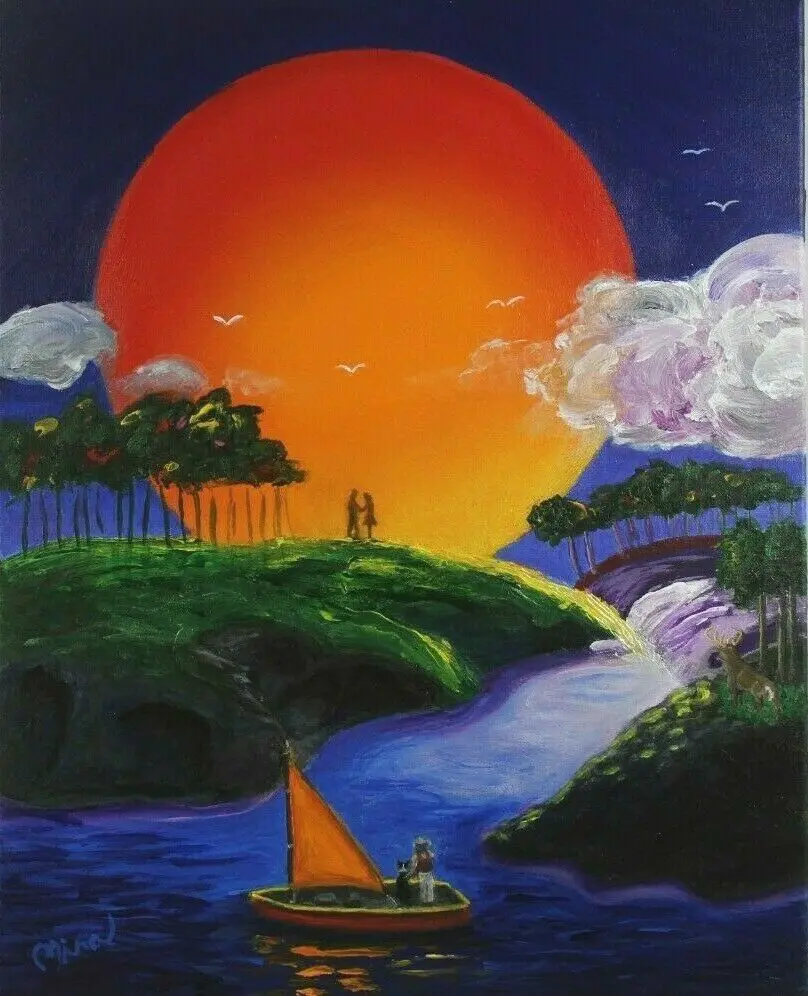
Engaging The Sun
Another major diversion from Peter Max is Mira’s frequent use of touches of realism alongside the pop-art scene. With Engaging The Sun, Mira adapts Peter Max’s Without Borders to his own style. The title is represented primarily by the couple in the center, in silhouette: the man is about to ask the woman to marry him. He asks for her hand; she puts it out in front of her; he grabs it in a strange way as he slips a ring onto her finger. It’s the exact moment of the painting — she hasn’t yet fully comprehended what’s happened, staring at the ring.
The couple is oblivious to the onlookers. A man and his dog have drifted in close enough to see what’s going on. A deer has slipped out of the woods from cover to take in the rare sight. The sun and landscape appear in pop-art style; the couple, the man with his dog, and the deer are painted in realism.
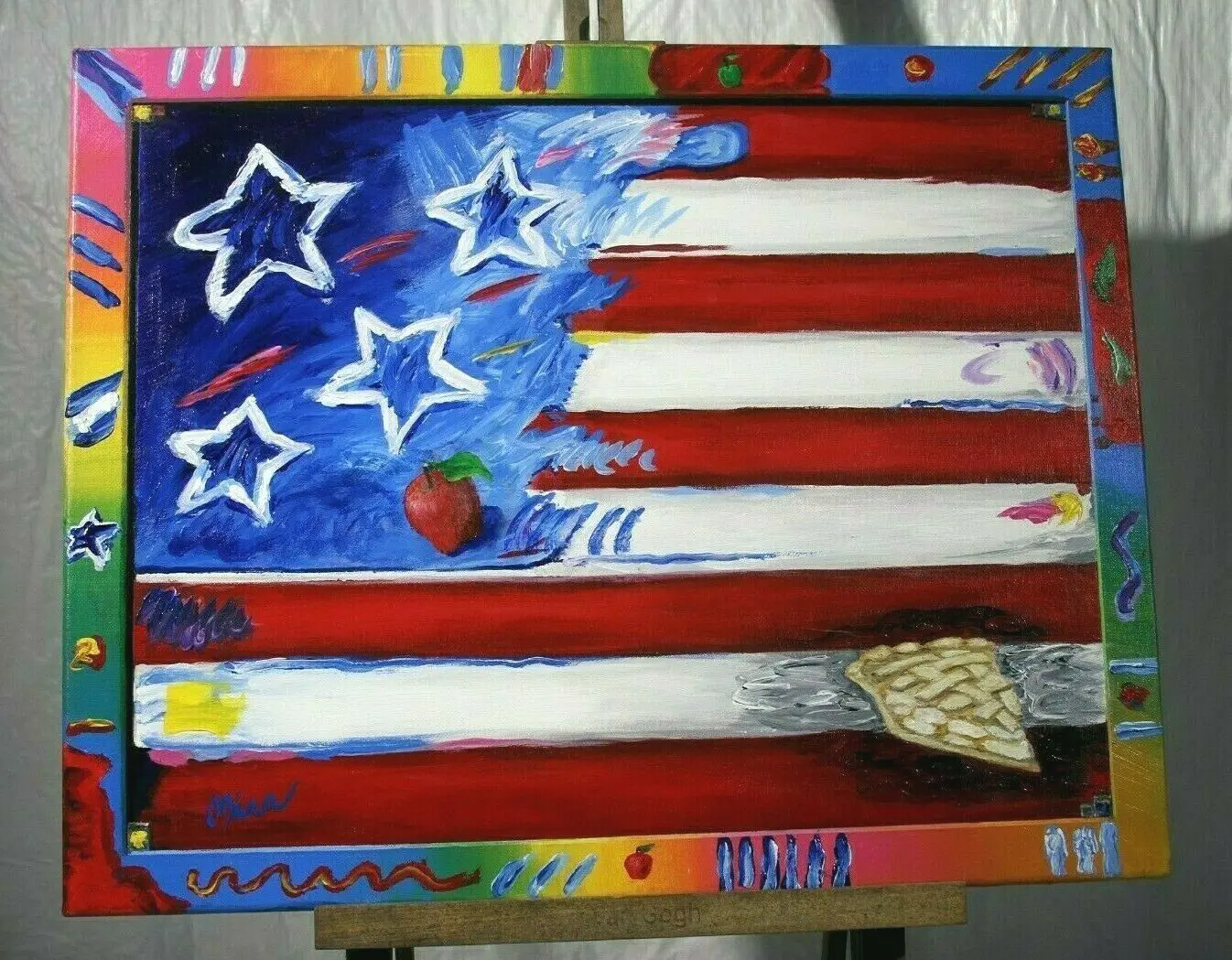
American Pie
The use of realism has become one of Mira’s key characteristics and a major diversion from Peter Max. Engaging The Sun is available in our Art and Paintings.
Mira also turned Peter Max’s flags-with-painted-frames concept into a realism exercise, making the frames faux. At first glance, both American Pie and US Liberty Flag with Heart and Moon appear to be hung in frames painted to complement the piece. What Mira actually did was paint the entire image — frame included — onto a single canvas, aging effects and all, so convincingly it reads as a physical wood frame in photographs.
American Pie carries the patriotic statement that something “is as American as apple pie” — and goes deeper: everyone getting their own “slice of pie,” with the apple representing love, temptation, health, and knowledge. The original is available in our Art and Paintings.
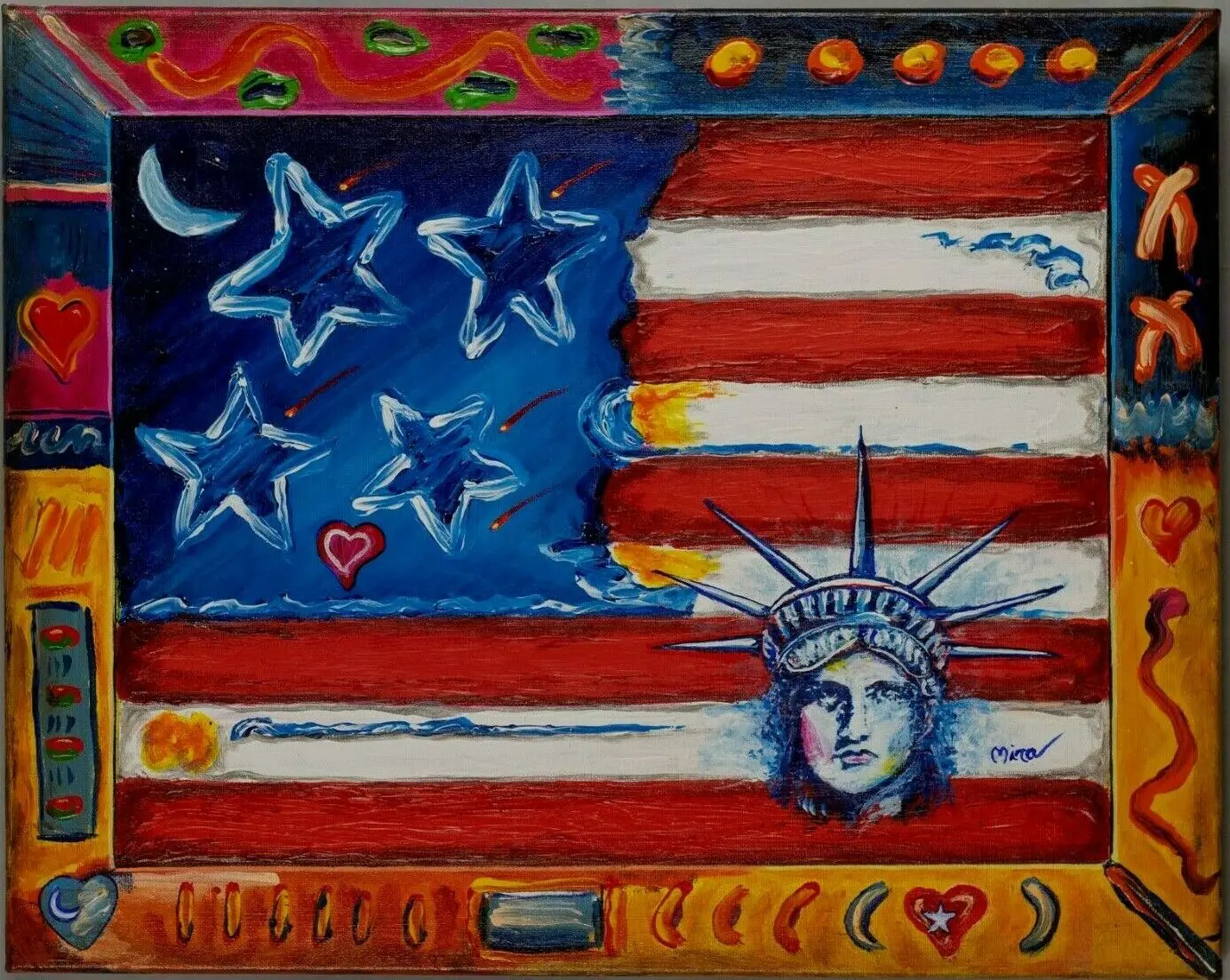
US Liberty Flag with Heart and Moon
In US Liberty Flag with Heart and Moon, the same painted-frame illusion applies, further enhanced by varnishing the frame area in satin and the flag portion in high gloss. Patriotism is the strong theme, with the Statue of Liberty portrait on the flag; various hearts suggest love of country; the moon nods to the line in The Star-Spangled Banner: “gave proof through the night that our flag was still there.”
Original Characters: A Parallel Universe
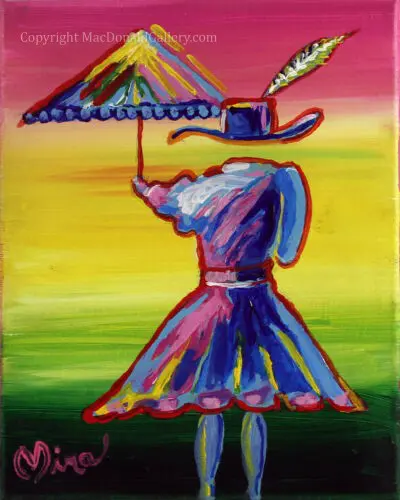
Umbrella Girl #1
Once realism and reinterpretation were established tools, Mira began inventing entirely new characters — building, panel by panel and painting by painting, a self-sustaining roster with its own internal logic. It started with Umbrella Girl #1, a direct answer to Max’s Umbrella Man: the brush strokes and colors harmonize similarly, but her umbrella is shaped like “the blade” — traditionally a symbol of manhood — held by a woman whose posture and wide-brimmed fedora signal a confidence entirely her own; the feather represents her freedom to do and be whatever she wants. A version of Umbrella Girl is available in our Art and Paintings.
From there the roster grew: Umbrella Couple, a tender pairing built from the same visual family as Umbrella Girl, but built around companionship rather than solitude; Neo Man, Neo Sisters, and Neo Dad, a triptych family whose sisters and father were designed to mirror Neo Man’s own energy and flow so closely that the three read as a single unit rather than three separate paintings; and Balloon Man and Umbrella Dog, continuing the line’s expanding cast.
Each new character deepens the same idea: Max built an extraordinary, iconic visual language, and Mira has spent years building an original cast of characters who live inside it — a parallel universe with its own family relationships, its own humor, its own quiet moments, standing beside Max’s world rather than copying it.
Mira to the Max: Framed Prints and Triptychs
Mira found a distinctive way to unite his own work with Max’s, in two related but different forms — and both are built on a principle he treats as non-negotiable: the original, licensed Peter Max print is never altered, painted over, or defaced.
Peter Max Prints Framed with Mira-Painted Mats. Mira sources authentic, increasingly rare Peter Max prints and book plates — often out-of-print editions he tracks down through ongoing, active searches, since many are no longer being produced. The print itself stays completely untouched. Around it, on the blank mat board, Mira extends the scene outward — continuing the color, composition, and mood of Max’s original as though the picture simply kept going past its own border. A thin white border is deliberately left showing between the print and Mira’s painted extension, so the transition is visible rather than hidden: it marks, honestly, exactly where Max’s hand stopped and Mira’s began. These framed editions have become an enormous hit with collectors and art connoisseurs and are consistently sold out. The most recent framed Peter Max rare prints and hand-painted mats are available in our eBay Store.
Framed Max/Mira Triptychs. In the triptych format, an authentic and increasingly rare Peter Max print sits, again untouched, in the center panel, flanked by two original Mira paintings — most often members of his own character line, built to relate directly to the Max print they surround, mirroring its energy rather than competing with it. This is the format behind the Neo Man / Neo Sisters pairing, and behind Peter Max’s Donald Duck flanked by Mira’s own Mickey & Minnie Mouse — most likely the last of that particular rare print Mira has been able to find, available in our Art and Paintings. These, too, have consistently sold out.
Both formats depend on the same discipline: real, physically sourced art history at the center, and an original, hand-painted response built around it — never a reproduction, and never an alteration of the source.
Paintings with Painted Frames
Mira’s latest collection takes off from Peter Max’s painted frames. Like Max, instead of a wood finish, the frames are painted to match and complement the painting — a technique Max is best known for on his flag paintings. Mira has taken it a step further and applied it across a complete array of subjects. When available, these Mira-painted-frame paintings are listed in our Peter Max – Juan Mira Pop Art category.
The Anatomy of a Master: “Jagger”
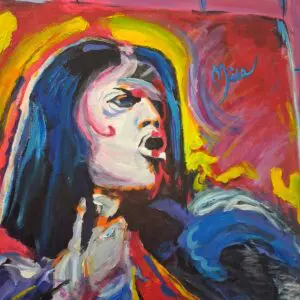
Mick Jagger — After Peter Max
That commitment to understanding Max from the inside out reaches its fullest expression yet in Mira’s most technically demanding piece to date: Mick Jagger — After Peter Max, a 20″×30″ acrylic on canvas.
Max’s own mixed-media portraits of this kind were built by layering acrylic overlays onto a printed photographic base — leaving certain passages, like an exposed hand, as untouched photograph beneath the paint. For Jagger, Mira set out to understand that construction well enough to build it from nothing: there is no printed base anywhere in the painting. Every passage Max would have left as raw photographic print, Mira built entirely by hand, matching the tonal and structural feel of a photograph before layering his own pop overlays on top — exactly as Max did on top of his.
Mira also pushed past Max’s own compositional structure: Jagger’s elbow, shoulder, and hand break forward beyond the painted border that contains the rest of the figure — a border Mira faithfully reproduces as Max’s own visual device, then treats as a stage edge rather than a boundary.
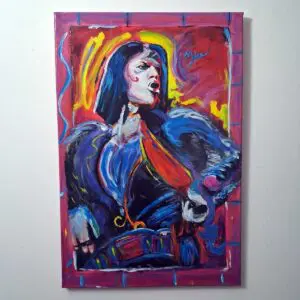
Mick Jagger — After Peter Max
Because the painted border serves as a frame on its own, the piece can hang bare or be framed conventionally, in the tradition of Max’s own originals. It’s a fitting culmination of everything the two-stage process and the “emotional ah” have been building toward — using Max’s own language to say something Max’s original never did. Jagger is an original, one-of-a-kind acrylic painting, hand-painted and signed by Juan Mira, finished with a professional isolation coat and removable conservation-grade varnish. It ships with MacDonald Gallery’s serial-numbered Certificate of Authenticity and is backed by the gallery’s Lifetime Collector Guarantee. Read the full story behind Jagger on the MacDonald Gallery blog.
Mira Fine Art Prints
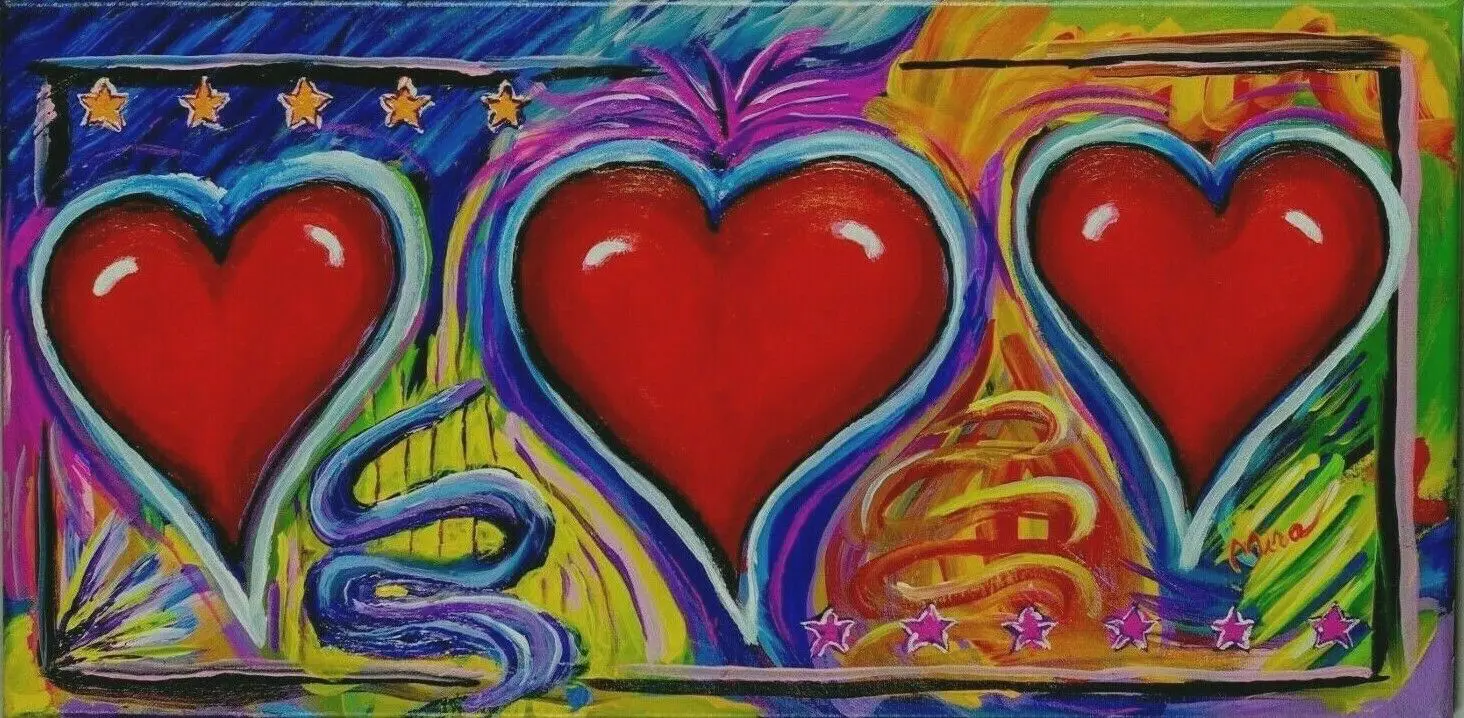
The popularity of Mira’s paintings has created steady demand for fine art prints of his work — a more accessible way to own a piece of it. For a personal touch, Juan Mira also produces a limited number of hand-embellished prints on paper and canvas. All Mira print formats, framed and unframed, are available through MacDonald Gallery’s Art Prints collection.